The Brand Compounding System: Making Every Marketing Dollar Build Your Next Win
Most brands treat marketing as a war of attrition. What if every campaign could compound into exponential growth?
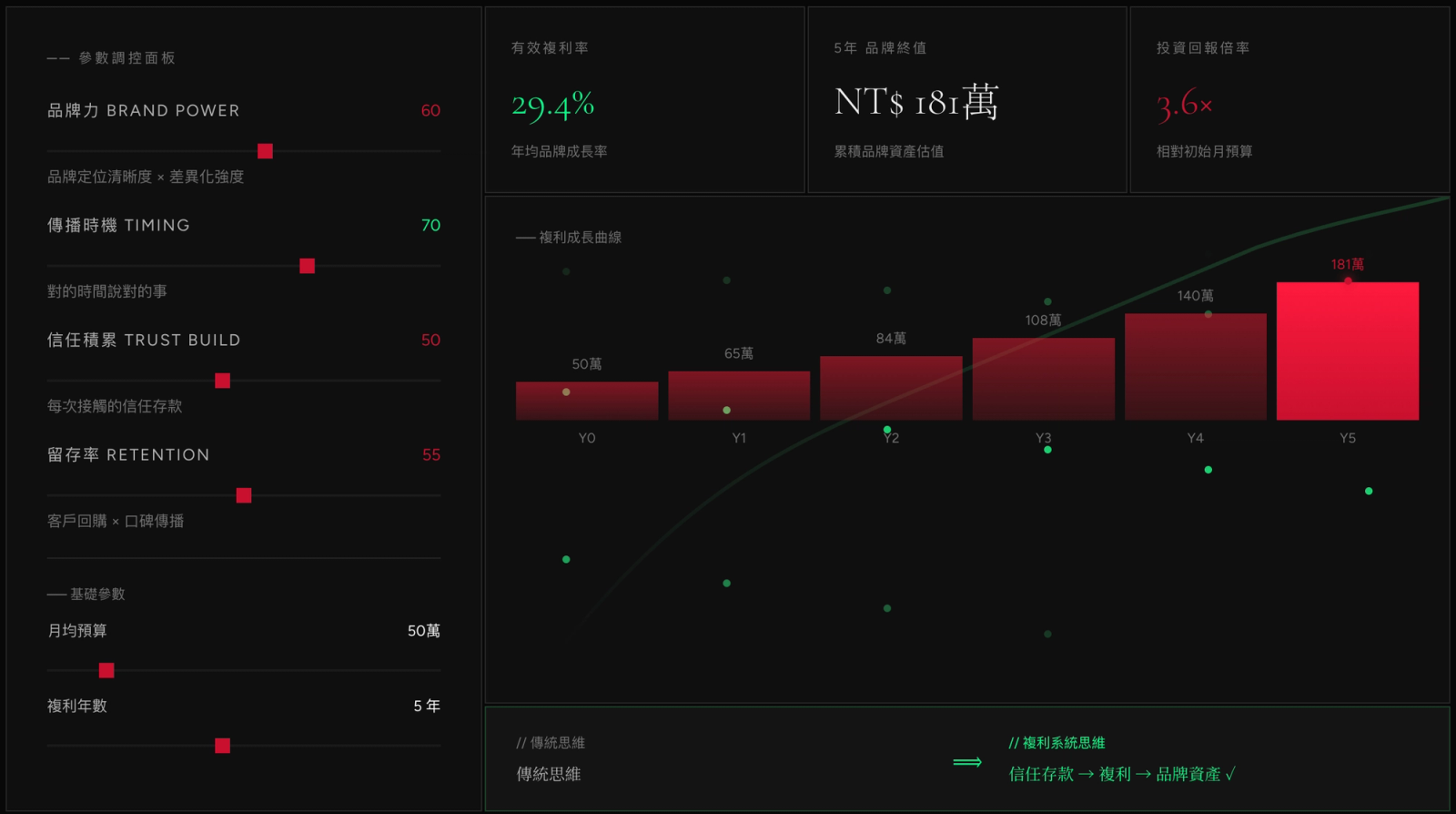
Most brand leaders slice their annual budget into isolated chunks: social ads here, influencer partnerships there, events in another bucket, SEO outsourced elsewhere. Each initiative runs independently, closes independently, reports ROI independently. It looks organized on paper. In reality, these marketing efforts share zero connective tissue—like dropping coins into separate piggy banks that never earn interest. This is why brands can spend five years 'doing marketing' yet see flat brand recognition. You're not compounding. You're just consuming budget.
First Principles: Marketing Builds Memory Links, Not Eyeballs
Start with the fundamental question: why market at all?
Your instinct says 'increase exposure' or 'boost conversions.' But those are symptoms, not the cause. The first principle of marketing is this: you're building memory links between your brand and solutions in consumers' minds. When they face a specific need, does your brand surface first? That's the only asset worth accumulating.
Viewed this way, the traditional 'which tool?' question reveals its flaw. Brand leaders ask: 'Facebook or Google ads?' 'Should we launch a podcast?' 'Is LINE Official worth it?' These questions assume a 'best tool' exists. The truth: no single tool creates memory on its own. Consumers don't remember you from one Instagram ad. They don't trust you from one email. Memory links require repeated exposure × diverse contexts × consistent messaging. It's a multiplication problem, not an addition one.
The Counterintuitive Insight: The Gaps Between Data Matter More Than the Data Itself
Most brands have Google Analytics, Facebook Insights, and e-commerce dashboards. But these data silos don't talk to each other. You know Facebook ads drove 5,000 clicks. You know your site had 8,000 visitors this month. But you don't know how much these audiences overlap. More critically, you don't know if people who saw your ad, visited your site, and followed your Instagram convert at three times the rate of single-touchpoint users.
These gaps—the unlinked, uncross-referenced spaces—are where brand compounding systems deliver value. When you can trace the full path (ad impression → site visit → content engagement → email open → purchase), you'll discover something surprising: conversions rarely happen at the last touchpoint. They're triggered by 3–7 accumulated interactions across different channels. If you treat each channel as an isolated event, you'll misjudge which investments work and which to cut.
The core value of a brand compounding system is revealing the chemical reactions between marketing efforts—not just their isolated physics.
Systems Thinking: Why Brands Need an 'Operating System,' Not a Toolkit
Imagine building a house. You can buy premium concrete, expensive rebar, beautiful tiles—but without architectural blueprints, these materials remain a pile of supplies. Brand marketing works the same way. Facebook, Google, SEO, and content marketing are materials. Without a systematic brand strategy framework, these tools never achieve synergy.
A brand compounding system provides operating-system logic: first, define which key moments in the consumer decision journey your brand must occupy. Then, assign corresponding content formats and channel combinations to those moments. Finally, establish feedback loops so every execution's data refines the next strategy. This isn't something you buy as software—it's building a complete architecture of strategy framework → content system → data feedback loop.
Real example: a health supplement brand used to run quarterly promotions, burn ad budget, then watch traffic drop to zero when the campaign ended. After implementing a compounding system, they shifted approach: use SEO content to capture long-tail searches around common health questions, use Instagram to build lifestyle brand affinity, use LINE Official for deep member segmentation, use email for post-purchase education and repurchase nurturing. Three months later, even without active ads, they had steady organic traffic and conversions—and these customers' LTV (lifetime value) was 2.3× that of ad-driven traffic. Why? Multi-touch engagement built brand belief, not just price response.
Planning and Management: From 'Tactical Execution' to 'Asset Stacking'
Traditional marketing planning is time-driven: Q1 does this campaign, Q2 runs that promotion, each quarter operates independently. Compounding system planning is asset-driven: every marketing effort must answer—what cumulative asset does this create? How can we leverage this asset next quarter?
Specifically, a brand compounding system categorizes marketing investments into three layers. First: consumable assets (single ad impressions). Second: reusable assets (product videos shot, SEO articles written). Third: compounding assets (accumulated brand search volume, member lists, content libraries). A healthy marketing mix should be 20% consumable, 30% reusable, 50% compounding. Most brands run the inverse ratio—80% of budget burns on consumable exposure.
On the management side, compounding systems emphasize 'North Star metrics' over vanity metrics. Don't chase follower counts or likes—numbers easily gamed. Lock onto metrics that reflect true brand asset accumulation: branded search volume, repeat purchase rate, organic content share rate. When you manage with the right metrics, team behavior shifts—away from chasing short-term spikes, toward ensuring every execution adds to long-term equity.
The Tipping Point: From Linear to Exponential Growth
The most powerful aspect of brand compounding systems is breaking the 'effort equals proportional return' trap. Most brand growth is linear: spend X budget, get corresponding exposure and conversions. Stop spending, growth stops. But when your marketing system starts compounding, the growth curve turns exponential. Content assets, brand awareness, and member relationships accumulated early begin self-reinforcing past a certain threshold—producing '1 unit in, 3 units out' leverage.
This tipping point typically arrives when the brand establishes a 'self-reinforcing loop.' For example: quality content drives organic search traffic → traffic converts to members → members repurchase and refer new customers → new customer data optimizes content strategy → more precise content attracts higher-quality traffic. Once this cycle spins up, the brand no longer needs to continuously burn cash for exposure—the system generates its own momentum.
Of course, building this system requires patience. The first three to six months may not show explosive growth—you're laying foundation, accumulating assets. But once the system engages, you'll notice dramatically improved resilience. Even if one ad channel underperforms, momentum from other accumulated assets supports revenue. Even if budget shrinks, long-accumulated brand searches and content assets continue driving traffic. That's the real value of compounding: transforming brand building from a 'burn cash for exposure' consumption war into a 'stack assets' long game.